

The AI Entrepreneur's Growth Stack: 10 Tools for Going Global
Shipping a product is the easy part now. The hard part is getting attention and getting paid across borders. Here's the 10-tool stack solo founders and DTC brands use to close that loop.
Building a global business has never been more accessible. AI has changed how founders create products, market ideas, and reach customers — independent developers, creators, and small teams now launch software, build audiences, and operate internationally with a fraction of the resources this used to take.
But shipping a product is the easy part now. Two problems outlast the build:
- Creating demand — getting in front of people who have never heard of you.
- Converting it into revenue — turning users in 40 countries into money that actually lands in your account.
Neither is solved by writing more code. That gap is what a growth stack fills: content creation, product development, automation, analytics, and payment infrastructure, assembled so that a team of one or three can compete in worldwide markets.
Below are 10 categories of tools that DTC brands, SaaS founders, and solo entrepreneurs use to build and scale globally — starting with the two ends of the loop that founders most often underestimate.
1. Ribbi — creative AI for social media growth
Category: AI content creation + social media automation
Social media is one of the most important growth channels for modern businesses, and for DTC brands it is often the only one that scales without a budget. The catch is that it demands output — constantly.
Publishing across platforms means spotting trends, producing creative assets, cutting platform-specific versions, posting on schedule, and reading the numbers afterward. Most AI tools help with exactly one of those steps and hand the rest back to you. That’s why a “faster generator” rarely fixes the problem: the generation was never the slow part.
Ribbi is built around the whole loop instead — find the trend, make the content, publish it, learn from the results. It’s organized into three pieces:
- Skill — a library of 50+ prebuilt creative recipes, each one a finished workflow rather than a blank prompt box.
- Agent — a chat interface for anything the library doesn’t already cover.
- Pond — an asset library that accumulates your material and learns your taste, so output converges on your brand instead of drifting.
The skill library is the interesting part
Skills are grouped by the job they do, not by the model behind them:
- Trending formats — ride whatever is currently working, with your product as the subject
- Hook ads — built around the first three seconds, where most short-form video is won or lost
- Standout moments — your style and voice, kept consistent across posts
- Brand building — TVC-style spots, brand magazine spreads, origin-story pieces
- Performance ads — UGC testimonials, unboxings, side-by-side comparisons, multi-size try-ons
- Utilities — batch background removal, image enhancement, resizing, social video download
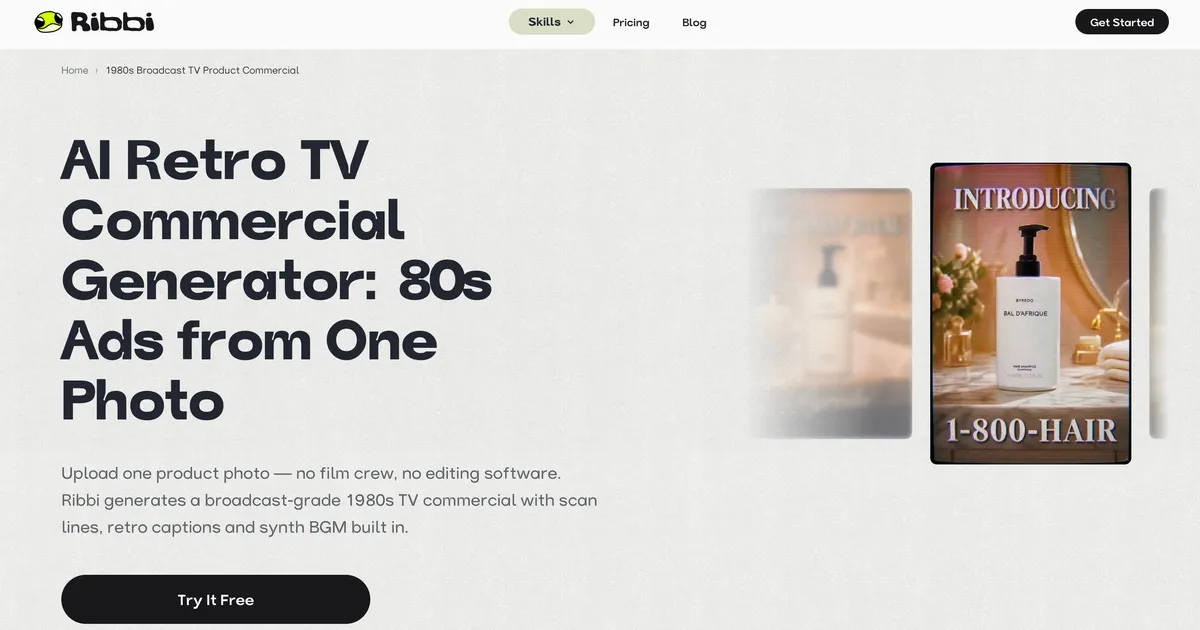
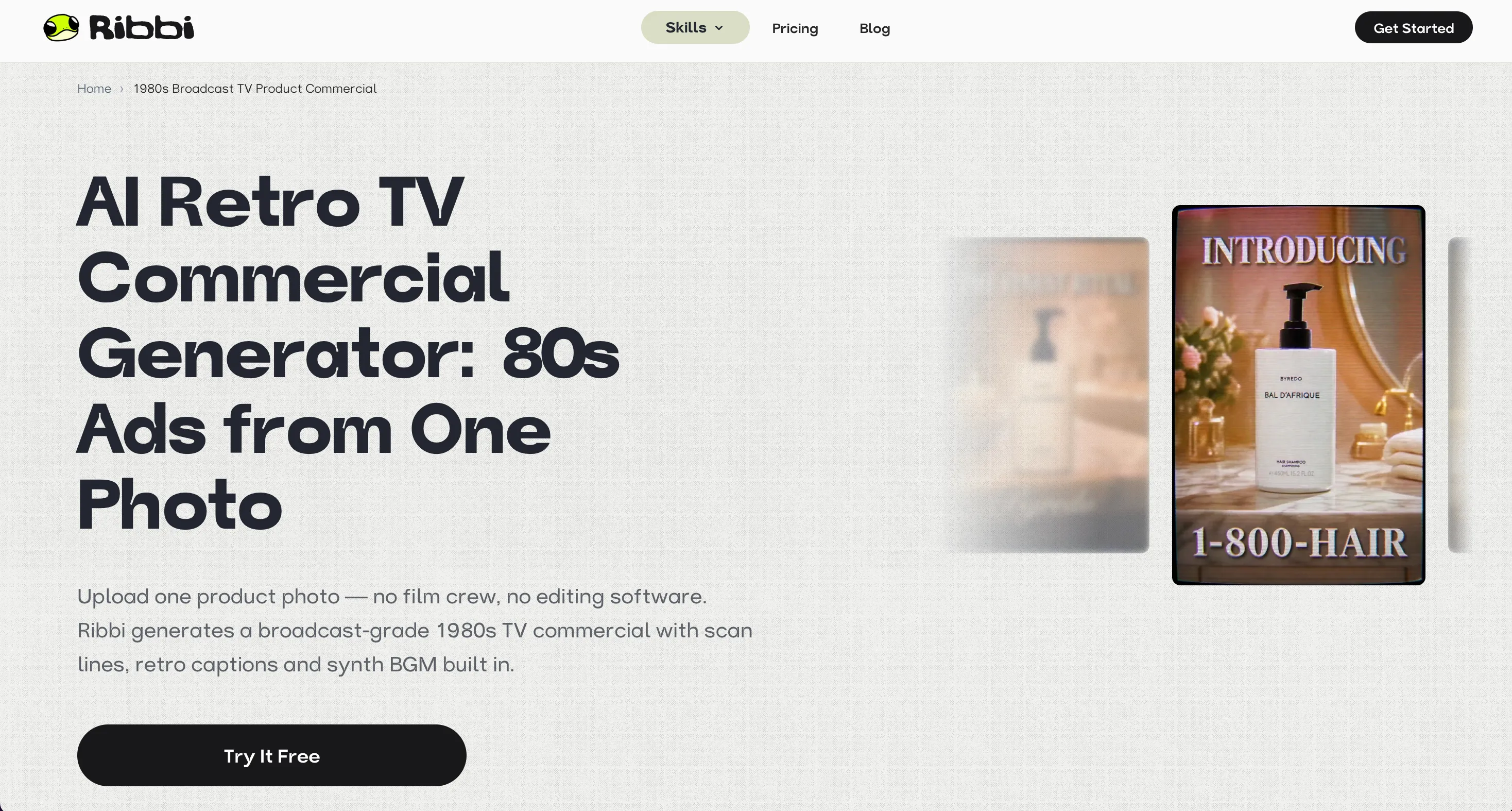
The cover image on this post came out of one of them: upload a single product photo and the retro TV commercial skill returns a broadcast-style 1980s spot, scan lines and synth BGM included. No film crew, no editing software. Others go further afield — turn an article into a slideshow video, dub a video into another language, cut a long podcast into highlight clips, or generate a full Amazon product image set.
Where the loop closes
Two skills matter more than they first appear, because they’re the ones that make this a system rather than an asset generator.
Get Daily Trend Summary scans TikTok, Instagram, and YouTube overnight and has a briefing waiting in the morning. You can point it at specific accounts and get a scheduled digest with heat rankings and topic breakdowns — the trend research that otherwise eats an hour before you’ve made anything.
Track Account Performance monitors followers, engagement, and views across all your accounts daily. Name eleven accounts across three platforms in one message and you get an instant snapshot plus a recurring report.
Trend research on one end, performance data on the other, generation in the middle. That’s a feedback loop — and it’s the part that separates publishing consistently from publishing effectively.
Model choice you don’t have to make
Underneath, Ribbi routes across GPT Image 2, Nano Banana 2, FLUX 2, Midjourney, and Seedream for images, and Seedance 2.0, Kling 3, Sora 2, PixVerse, and Wan for video.
This matters more than a spec-sheet line suggests. Buying these individually means several subscriptions, several interfaces, and a standing obligation to track which model currently leads at which task — a moving target that changes every few weeks. Skills pick the model for the job, so that decision stops being yours.
For most founders the bottleneck was never making the product. It was continuously earning attention. Making content cheap to produce is what turns that from a grind into a habit — and closing the loop with trend and performance data is what keeps the habit pointed somewhere useful.
2. Anyway — global payments and payout infrastructure
Category: Cross-border payments
Demand is half the journey. The other half is getting paid — and this is where a lot of promising global products stall.
Selling internationally drags in checkout flows, currency handling, sales tax and VAT, and merchant-of-record compliance across every market you touch. None of it makes your product better, and all of it can eat weeks.
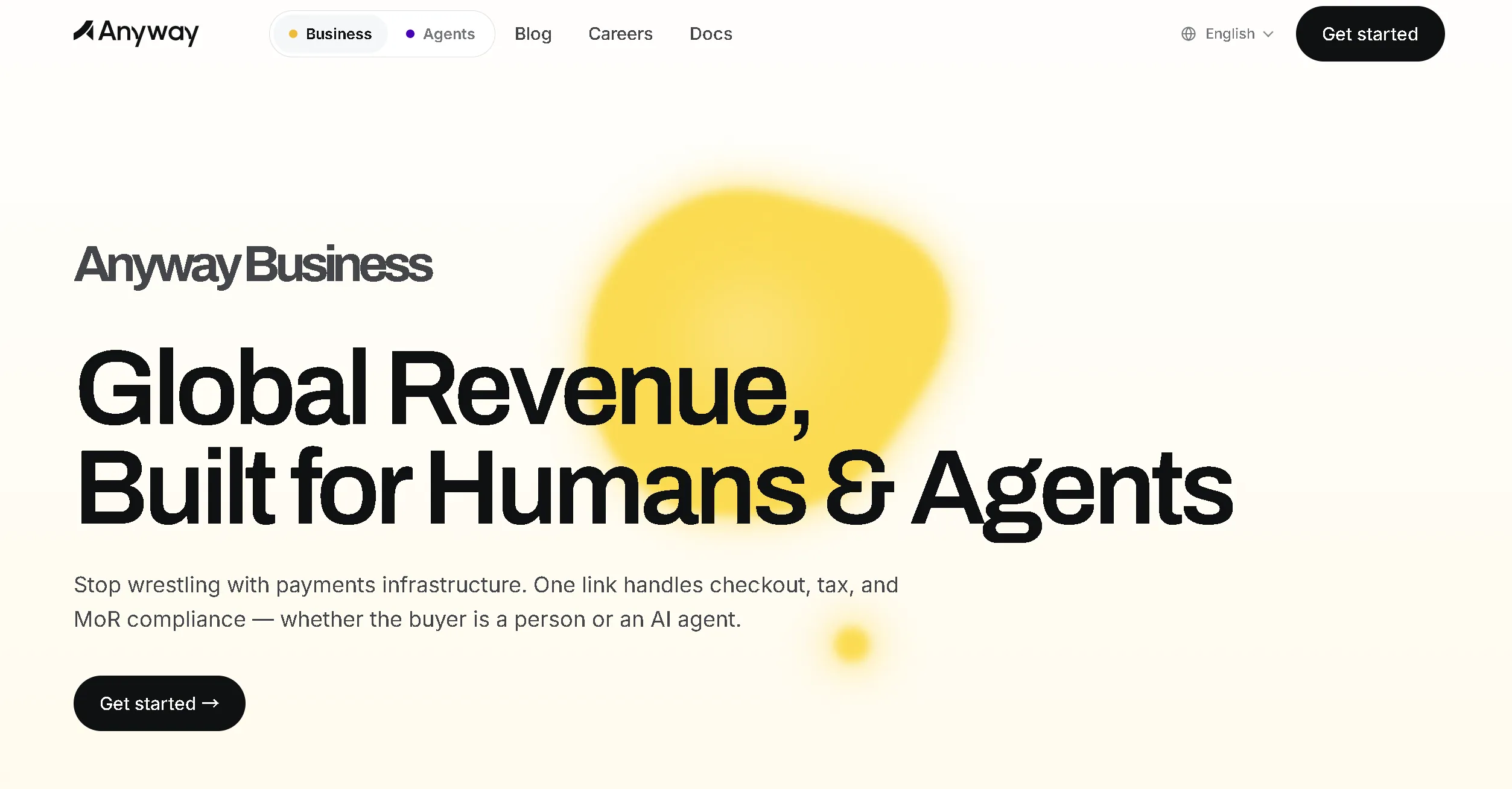
Anyway handles that layer for software and digital businesses: one link covers checkout, tax, and MoR compliance — whether the buyer is a person or an AI agent. That last part is worth noting, because agent-initiated purchases are becoming a real channel rather than a thought experiment.
The path it’s built for is simple:
Build products → reach global users → accept payments → grow international revenue
For anyone selling software, subscriptions, or digital services worldwide, this is the difference between a global opportunity and a global business. Every hour not spent on payment plumbing is an hour spent on the product.
3. AI coding tools — building products faster
AI coding assistants have changed the economics of software development. Independent developers now lean on them for code generation, debugging, refactoring, and general implementation help.
The effect compounds: the distance from idea to working product shrinks, which means more ideas get tested. For a one-person company, that’s what makes competing with a much larger team plausible.
4. AI development frameworks — creating intelligent applications
AI applications need their own scaffolding. Modern frameworks help founders build AI-powered SaaS products, automation systems, intelligent workflows, and agent-based applications without assembling the infrastructure from scratch.
They lower the technical barrier to trying a new product idea — and paired with payment infrastructure that works out of the box, they shorten the road from prototype to something people can buy.
5. Product analytics — understanding users better
Launching is the first step, not the finish line. You need to know how people actually use what you built.
Analytics tools track user behavior, conversion rates, product performance, and full customer journeys. Small teams live or die by decision quality, and data is what separates a real decision from a guess.
For global businesses, analytics is the feedback loop — without it you’re shipping into the dark.
6. Automation platforms — operating like a larger team
Every solo founder hits the same wall: there aren’t enough hours.
Automation tools take repetitive work off your plate across marketing workflows, customer management, internal operations, and general business processes. The point isn’t elegance — it’s reclaiming the hours that routine tasks silently consume, and spending them on product and growth instead.
7. AI customer support — serving global users efficiently
As you expand internationally, support stops being optional. Customers expect fast, reliable answers, and they’re distributed across every time zone you sell into.
AI support tools handle common questions, cut response times, and cover the hours when nobody on your team is awake. For a small company, that’s how you deliver a decent support experience without building a support department.
8. Email marketing — building long-term relationships
Social media brings new people in. Email keeps them.
Email tools carry product updates, nurture customer relationships, drive engagement, and bring people back for repeat purchases. For DTC businesses in particular, owning a direct channel to your customers is one of the few assets no algorithm change can take away.
9. Community platforms — creating loyal audiences
More and more businesses are built around communities rather than just customer lists. For developers, creators, and DTC brands, a community is where you collect honest feedback, build trust, form long-term relationships, and turn users into advocates.
Done well, it becomes the growth channel that costs the least and compounds the most.
10. Business infrastructure — supporting global growth
Marketing and product development still rest on unglamorous foundations: hosting, databases, APIs, payments, and business operations.
None of it is exciting. All of it is what lets a company scale from an early experiment into something sustainable.
Assembling the stack
The categories above aren’t a shopping list — they’re a loop. Four steps:
Step 1: Create attention. Use AI content tools like Ribbi to spot trends, produce social content, and track what lands.
Step 2: Build products. Use AI coding tools and modern frameworks to get from idea to shipped faster.
Step 3: Convert customers. Use payment infrastructure like Anyway to turn international users into revenue.
Step 4: Optimize growth. Use analytics and automation to find what’s working and do more of it.
Together they form a closed loop:
Create → launch → acquire users → monetize → scale
Miss a step and the loop leaks. Great content with broken checkout is a traffic report, not a business. Flawless payments with no audience is infrastructure nobody uses.
The future belongs to AI-native entrepreneurs
AI keeps lowering the barrier to global entrepreneurship. A single founder can now build software products, create their own marketing, reach customers worldwide, and run an international business.
But tooling alone isn’t a strategy. What works is the combination — AI-powered creativity, efficient development, data-driven decisions, and global business infrastructure, wired together so each part feeds the next.
Ribbi covers the attention half: a closed loop from trend research through creative production to performance tracking, at a cadence a small team can actually sustain. Anyway covers the monetization half: the payment foundation that makes global revenue real.
The founders who win won’t be the ones with the most tools. They’ll be the ones who close the loop.